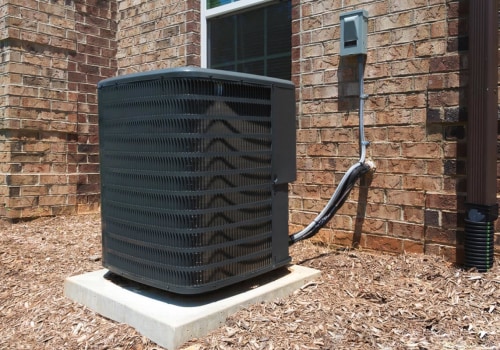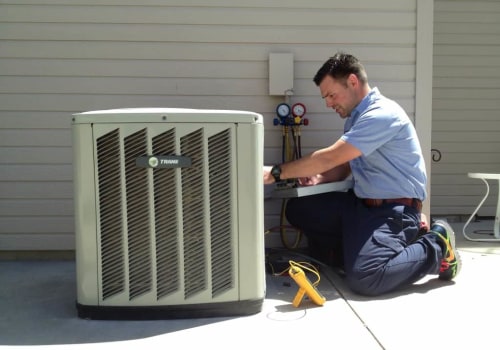
In the attics of Coral Gables, we see the same problem over and over. A four-month-old fiberglass pad sits loose in the 13x21.5x4 slot. The evaporator coil behind it is matted with compacted gray dust. The homeowner wonders why the electric bill keeps inching up. Every one of those symptoms started with the cheapest filter on the hardware store shelf.
That's why the 13x21.5x4 filter you choose matters far more than the price tag on the box. Coral Gables runs the AC ten months a year. Salt air corrodes anything metal. Humidity turns ordinary dust into a sticky coil-clogger. The media inside that four-inch slot quietly decides how long your blower lasts, how clean the air your family breathes actually is, and how often you climb into the attic to swap it out.
An air filter is a device built to trap solid particles out of the airstream: dust, pollen, mold spores, pet dander, and some smoke. In a home HVAC system, it has two jobs. Protect your equipment, and protect the people breathing the air. What's inside the frame decides how well it does both.
TL;DR Quick Answers
Pleated beats fiberglass for nearly every Coral Gables home.
Start at MERV 11 pleated. Step up to MERV 13 if anyone in the house has allergies, asthma, or if you have pets. The MERV rating guide walks through the differences by health profile.
Change pleated every 60 to 90 days. Change fiberglass every 30. The filter replacement basics cover the full cadence by filter type.
Pleated costs roughly $40 to $50 more per year, saves $100 or more on energy, and extends coil life by years.
13x21.5x4 is a real size. Buy the exact spec. Never substitute.
Top Takeaways
Capture efficiency doesn't compare. A MERV 11 pleated traps roughly 85% of fine particles down to one micron. A MERV 2 fiberglass catches about 10% of the same particles. Pollen, smoke, and mold spores pass right through the cheap option.
Lifespan narrows the cost gap. Pleated runs 60 to 90 days. Fiberglass runs 30. You're buying fewer filters per year with pleated even though each one costs a little more.
Coil protection is where the real money lives. Clean media extending system life by years saves you the cost of an evaporator coil replacement, which isn't a small bill in South Florida.
Most Coral Gables homes land on MERV 11 pleated. It captures what matters for health without making the blower work harder than it should.
If you have pets, an allergy sufferer in the house, or a home near a busy road, step up to MERV 13. The extra filtration pays off fast when the particle load is higher.
Always check the frame stamp. 13x21.5x4 does not interchange with 14x22x4. If you're not sure what size your system takes, furnace filter fundamentals shows you how to read the frame.
What Pleated 13x21.5x4 Filters Actually Do
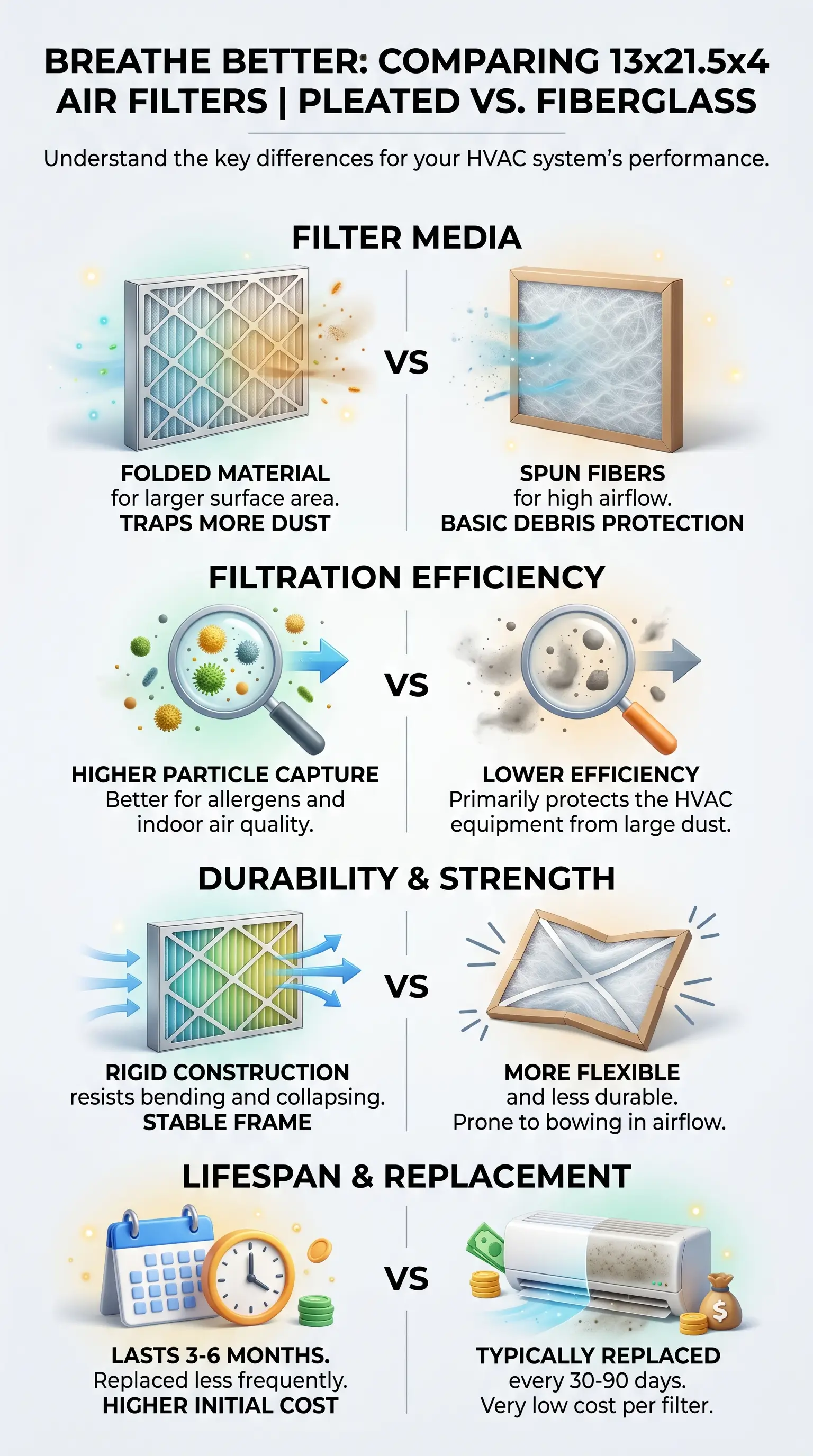
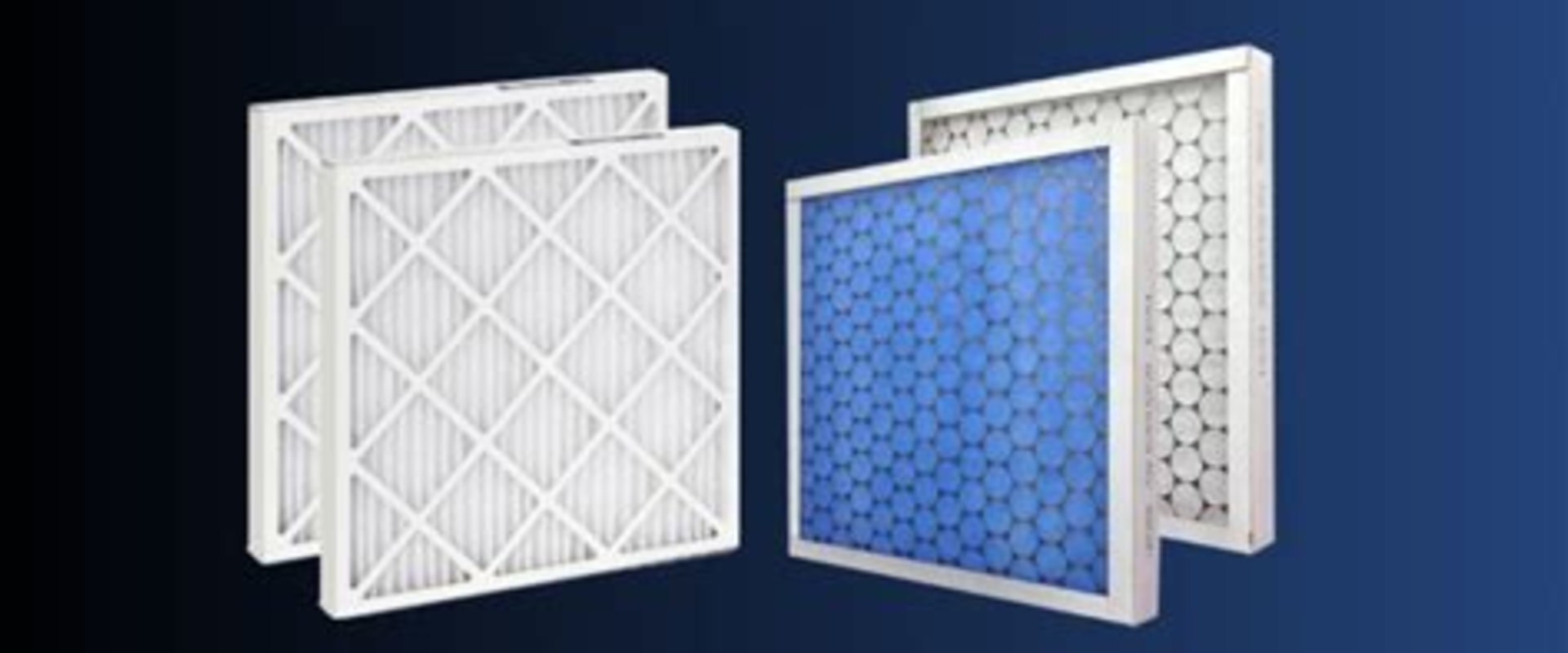
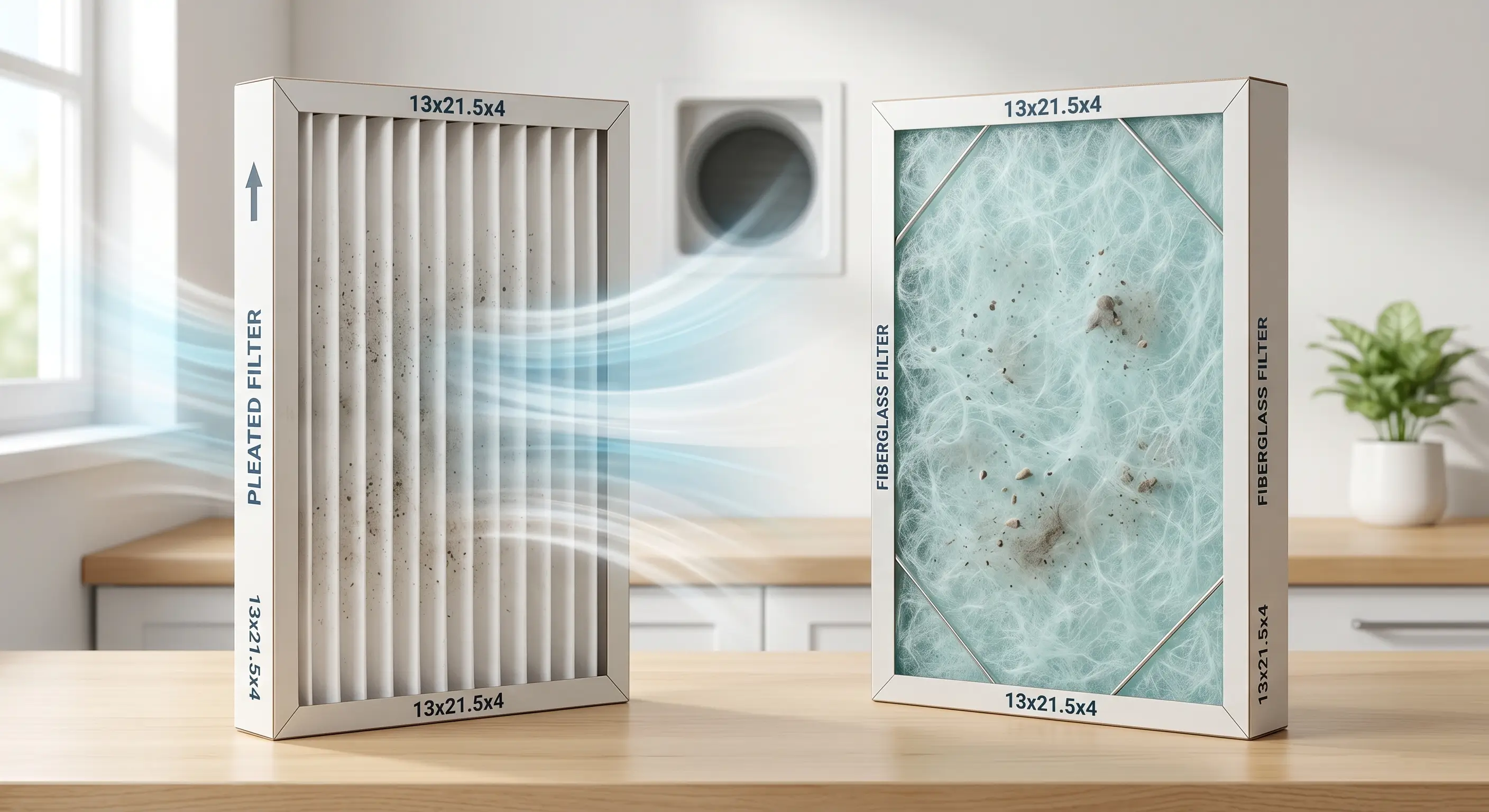
Pleated filters use accordion-folded synthetic or cotton media to create a far larger surface area than a flat pad can offer. For a four-inch-deep filter like the 13x21.5x4, that pleating gives you three to five times the trapping surface of a standard one-inch filter. Two things happen at once. The filter captures finer particles, and it does so without starving the blower for air. The filtration science explained in deeper technical writeups is straightforward: more media, slower face velocity, more contact time with each passing air particle.
Most pleated 13x21.5x4 filters land between MERV 8 and MERV 13. That range captures household dust, bacteria, smoke, and the fine particles that make asthma worse. In a typical Coral Gables home, the 4-inch filter lifespan runs 60 to 90 days between changes.
What Fiberglass 13x21.5x4 Filters Actually Do
Fiberglass filters are the cheapest option on the shelf: a flat blue or green mat of spun glass fibers in a cardboard frame. Manufacturers never designed them to clean the air you breathe. They exist to keep large debris (lint, hair, big dust bunnies) from jamming the blower motor. Fiberglass filters rate MERV 1 to MERV 4, which means pollen, mold spores, pet dander, and smoke pass right through. They run under $8 each, but they need swapping every 30 days, and every day they sit in your slot, fine particles are building up on the evaporator coil. Comparing filter media side by side makes the efficiency gap obvious in seconds.
Head-to-Head: The Differences That Matter
Capture efficiency goes to pleated by a wide margin. A MERV 11 pleated filter traps roughly 85% of airborne particles down to one micron. A MERV 2 fiberglass pad catches around 10% of the same particles.
Airflow on a modern four-inch pleated is easy on the blower. The deeper pleats keep face velocity and static pressure low. A one-inch filter at the same MERV would put more strain on your system than this four-inch pleated does.
Lifespan goes to pleated at 60 to 90 days. Fiberglass runs 30.
Coil protection is where the pleated upgrade pays for itself. An evaporator coil replacement is not a small bill in South Florida, and pleated is what keeps your coil from getting coated in the first place.
On budget, if the price jump is a sticking point, a MERV 8 pleated still outperforms any fiberglass option. The entry point to pleated is lower than most people think.
Why Coral Gables Homes Should Default to Pleated
Coral Gables homes deal with a heavier particle load than most of the country: year-round cooling runtime, sea-salt air, live-oak and royal-palm pollen spikes, Saharan dust events that drift in every summer, and mold spores riding the humidity. All of that favors higher-MERV pleated media as the default.
Duct performance matters just as much as the filter itself. The best filter in the world can't help if conditioned air leaks out of your ductwork before it reaches you. If no one has checked your ducts in a few years, air duct sealing is worth a call.
If you have pets, an allergy sufferer at home, or you live near US-1, step up to allergen defense options in the pleated family. Your lungs and your coil both come out ahead.
After more than a decade manufacturing filters and watching how they hold up in Coral Gables homes, I'll tell you what every neighbor learns sooner or later. A properly-sized pleated filter pays for itself in one cooling season through coil protection alone, and the only meaningful choice left is which MERV rating your blower can carry.
7 Essential Resources
Every source below is a primary, non-commercial authority. We use them ourselves when we need to check a specification, a health claim, or a testing method.
EPA — Guide to Air Cleaners in the Home. The federal government's plain-language primer on residential air cleaning, MERV, and HEPA.
U.S. Department of Energy — Air Conditioner Maintenance. Official guidance on filter replacement intervals and the efficiency cost of dirty filters.
ASHRAE — Standards & Guidelines. The engineering society that created the MERV rating system via Standard 52.2.
American Lung Association — Air Cleaning at Home. Health-first perspective on filtration from the nation's leading lung-health nonprofit.
CDC / NIOSH — Improving Air Cleanliness. The CDC's recommendation to upgrade to MERV-13 or better wherever HVAC systems allow.
ENERGY STAR — Heat & Cool Efficiently. EPA's efficiency program explains why a monthly filter check matters for utility bills.
Asthma and Allergy Foundation of America — Air Cleaners: What You Need to Know. How filter choice affects households with allergies or asthma.
3 Statistics You Should Know Before You Buy
Americans spend roughly 90% of their time indoors, which is why the air inside your home matters far more to your family's health than most people realize. Source: U.S. Environmental Protection Agency.
Indoor air can be two to five times more polluted than outdoor air, and occasionally up to 100 times more polluted. Source: American Lung Association.
Replacing a dirty, clogged air filter with a clean one can cut your air conditioner's energy use by as much as 15%. Source: U.S. Department of Energy.
Final Thoughts and Opinion
Fiberglass has its niche, but almost every home built after 1990 has outgrown it. The material was designed for an era when HVAC systems were simpler, houses were leakier, and indoor air quality wasn't something most people thought about. That era is over. Coral Gables homes today are tighter, HVAC systems are more sophisticated, and the particle load in South Florida air is higher than it has ever been. Traffic on US-1, construction dust, Saharan dust events, and seasonal pollen all end up inside your house, and your filter is what stands between those particles and your lungs.
A Prudent Protector running a MERV 2 filter in 2026 is protecting nothing. That's our opinion, and we'll stand behind it every day of the week. If the budget is really tight, buy fewer high-quality pleated filters and change them on schedule. Don't cycle through cheap ones every 30 days. For size-specific replacement schedule guidance by filter type, third-party resources can help you tune the interval to your exact setup.
Frequently Asked Questions
Is a 13x21.5x4 filter the same as a 14x22x4?
No. The nominal dimensions are close but the actual dimensions differ, and substituting one for the other creates gaps that let unfiltered air slip around the media. Always read the frame stamp on your current filter before ordering a replacement.
How often should I change a pleated 13x21.5x4 filter in Coral Gables?
Most homes run 60 to 90 days between changes. Cut that to 45 days if you have pets, construction going on nearby, or anyone in the house with asthma or allergies.
Will a MERV 13 filter damage my older AC?
Rarely, but check first. Most HVAC systems built after 2010 handle MERV 13 in a four-inch depth without issue because the deeper pleating keeps static pressure low. If your unit is older or you're uncertain, ask a licensed tech to check your maximum allowable static pressure before you upgrade.
Are fiberglass filters ever the right choice?
Only in narrow situations, like a very old blower that can't tolerate any resistance, or a household with zero allergy or air-quality concerns. For most Coral Gables homes, fiberglass is the wrong default.
Are washable filters a viable alternative?
Sometimes, especially in smaller systems where running to the store every month is a hassle. There are good guides to washable filter options and reusable alternatives that walk through the tradeoffs. Capture efficiency usually runs lower than disposable pleated. The upfront cost is offset by years of reuse if you clean them on schedule.
Can I stack two thinner filters to make a 4-inch?
Please don't. Stacking creates gaps at the seams that let unfiltered air bypass the media, and the combined pressure drop can damage your blower. Buy the right 13x21.5x4 depth every time.
What MERV rating do you recommend for a typical Coral Gables home?
MERV 11 pleated is our default. It captures the particles that matter for health without asking too much of the blower. Step up to MERV 13 if anyone in the home has respiratory concerns.
Ready to Upgrade? Here's Your Next Step
You already know what your family deserves. Cleaner air and a protected HVAC system. Stop settling for fiberglass pads that let half the particle load through and need swapping every month. When you're ready to restock, shop premium 13x21.5x4 air filters from Filterbuy. Every one is made in the USA, available in MERV 8, MERV 11, and MERV 13, and shipped direct to your door on a schedule you control.
Learn more about HVAC Care from one of our HVAC solutions branches…
Filterbuy HVAC Solutions - Miami FL - Air Conditioning Service
1300 S Miami Ave Apt 4806 Miami FL 33130
(305) 306-5027
https://maps.app.goo.gl/Ci1vrL596LhvXKU79